
Nuclear Fission · Reactor guide
Pressurized Water Reactor
The most common power reactor design, using high-pressure water as both coolant and moderator.
- Coolant
- Light water
- Moderator
- Light water
- Fuel
- Enriched uranium dioxide
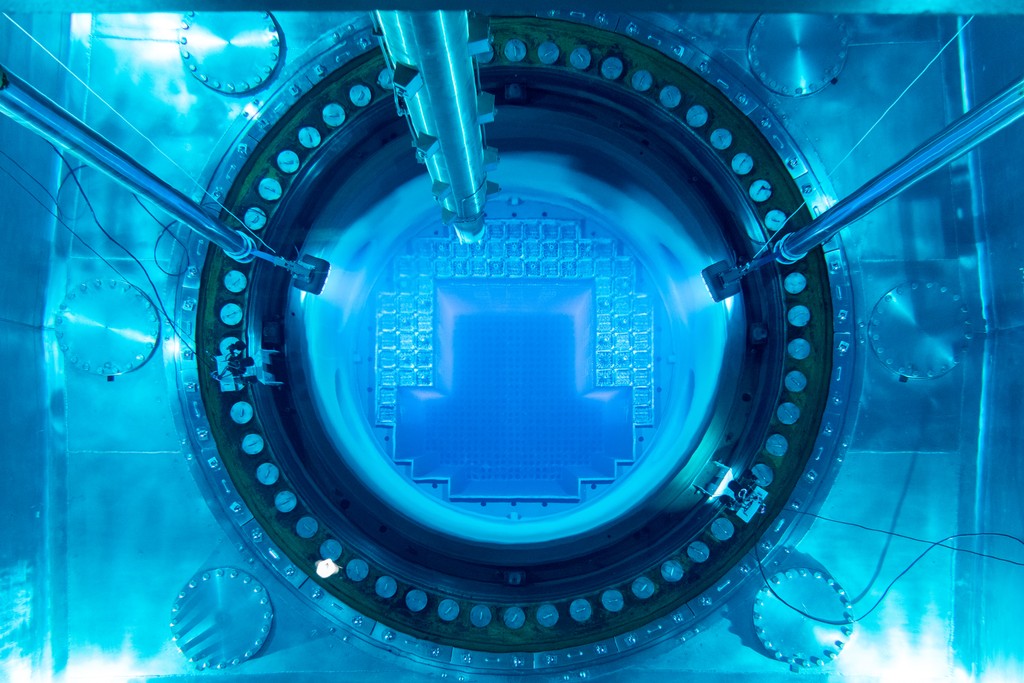
A pressurized water reactor (PWR) keeps water under high pressure so it can carry heat from the core without boiling. That hot primary water flows through steam generators, where it heats a separate secondary loop to produce steam for a turbine and generator.
PWRs are the dominant commercial design worldwide—used in U.S., French, Chinese, and many other nuclear fleets. Their two-loop layout keeps radioactive primary coolant out of the turbine hall.
How It Works
- Fission in fuel rods heats water in the reactor vessel (primary loop).
- A pressurizer maintains pressure high enough (~15 MPa / ~2,200 psi) that water stays liquid even near 300 °C.
- Reactor coolant pumps circulate primary water through steam generators.
- Secondary water boils in the steam generator shell side, steam spins the turbine, then condenses in the condenser (often cooled by river, sea, or cooling towers).
- Control rods and boron in the primary water adjust reactivity; safety systems inject water or boron if needed.
  [Core] → primary water (pressurized, radioactive) → [Steam generator]
                                                          ↓
                                              secondary steam → [Turbine] → electricity
Main Systems
| System | Role |
|---|---|
| Reactor vessel | Houses fuel, control rods, and primary coolant |
| Steam generators | Heat exchangers between primary and secondary loops |
| Pressurizer | Maintains primary pressure; accommodates water expansion |
| Control rods | Absorb neutrons; insert to shut down |
| Chemical shim (boron) | Dissolved boron absorbs neutrons for fine reactivity control |
| Containment building | Steel/concrete barrier around reactor systems |
| Emergency core cooling | High-pressure and low-pressure injection if coolant is lost |
Fuel is typically uranium dioxide (UO₂) pellets in zirconium alloy cladding, enriched to several percent U-235. Burnup is refueled on an 18–24 month outage cycle in batches.
Safety Features
- Negative reactivity feedback: Water density and temperature changes tend to reduce power if the core overheats (design-dependent but generally stabilizing for PWRs).
- Redundant cooling: Multiple trains of emergency injection and feedwater.
- Containment: Designed to hold pressure after pipe breaks and limit release.
- Defense in depth: Layered barriers—fuel cladding, primary circuit, containment, site planning.
Major accidents involving PWRs (e.g., Three Mile Island) usually involve equipment failures plus procedural or training issues, not a single missing wall. Lessons drove better instrumentation, operator training, and probabilistic safety analysis.
Where It Is Used
- United States: Majority of the fleet (e.g., Vogtle, Palo Verde).
- France: Standardized 900 MWe and 1,300 MWe designs; high nuclear share of electricity.
- China, South Korea, Japan: Large modern construction programs and exports.
PWRs are the reference design for many Generation III+ plants (e.g., AP1000, EPR) with passive safety features such as gravity-driven cooling.
Tradeoffs
| Advantages | Disadvantages |
|---|---|
| Proven, large industry experience | Two loops + steam generators add cost and complexity |
| Primary coolant stays liquid; stable thermal feedback | Primary side is radioactive—maintenance inside vessel is difficult |
| Turbine equipment avoids direct contact with reactor water | Boron chemistry and PWR water chemistry require careful management |
Compared to a boiling water reactor, the PWR separates radioactive primary water from the turbine. Compared to CANDU, PWRs need enriched fuel but use a single large pressure vessel instead of many pressure tubes.
Key Takeaways
- PWRs use pressurized light water as coolant and moderator in one loop.
- Steam generators transfer heat to a non-radioactive secondary loop for the turbine.
- Control rods and boron manage power; containment and emergency cooling manage accidents.
- They are the most deployed electricity reactor type globally.