
Nuclear Fission
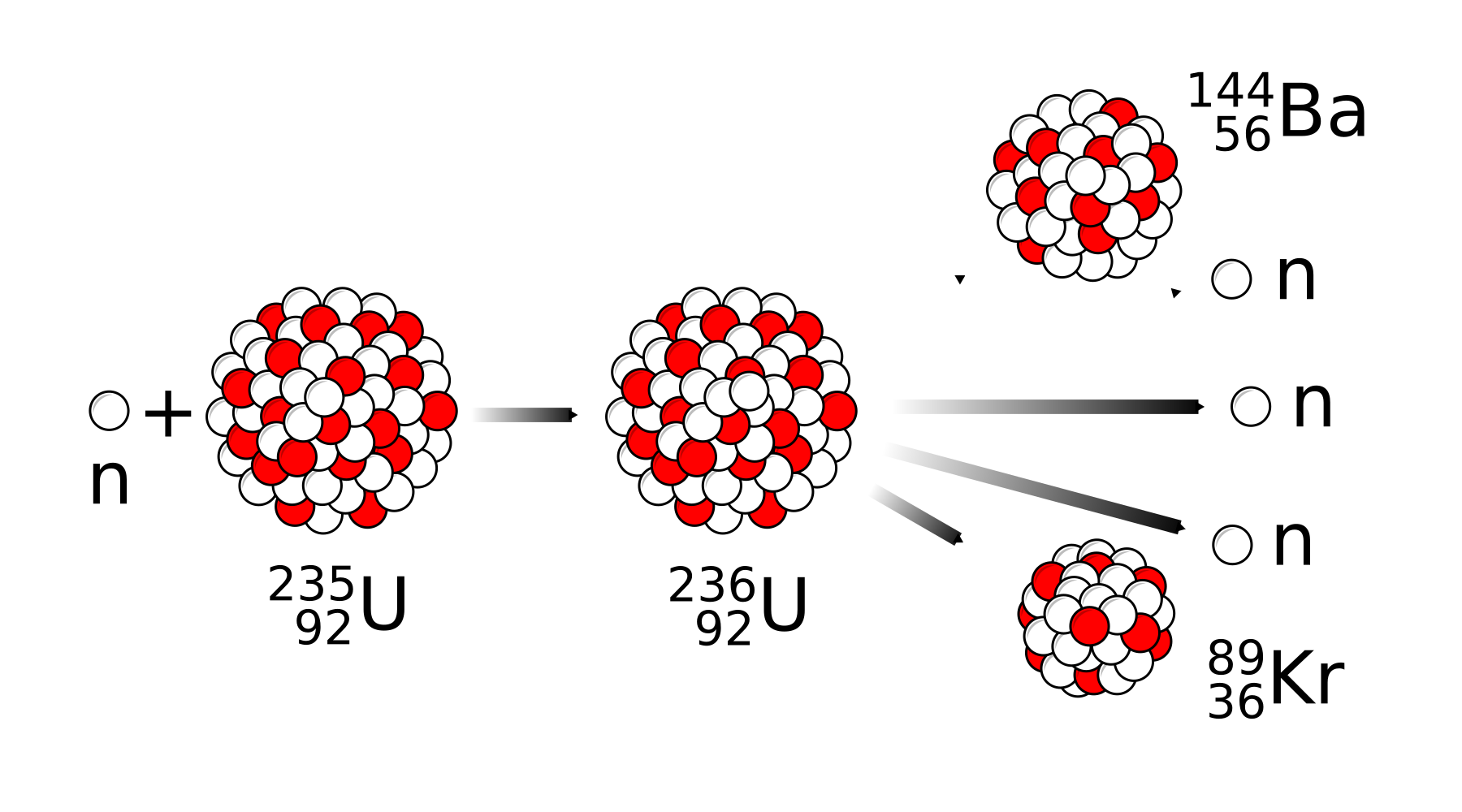
Image By MikeRun - Own work, CC BY-SA 4.0
Nuclear fission is the splitting of a heavy atomic nucleus into two (or occasionally three) smaller fragments, plus extra neutrons and a large release of energy. It is the process behind most nuclear power plants and nuclear explosives.
Fission is not the same as Radioactive Decay. Decay is a single nucleus transforming spontaneously, often slowly. Fission is typically triggered when a nucleus absorbs a neutron and breaks apart—and in a reactor, those extra neutrons can cause more fissions, sustaining a chain reaction.
This lesson follows the Atomic Fundamentals path (Atoms through Radioactive Decay). You should already know isotopes, neutrons, and why unstable nuclei release energy.
Why Heavy Nuclei Can Split
Very heavy nuclei, such as uranium and plutonium, pack many protons and neutrons into one nucleus. The strong force binds them, but proton–proton repulsion is strong at large size. Some heavy isotopes are fissile: if they absorb a slow (thermal) neutron, the resulting nucleus is so unstable that it splits almost immediately.
The fragments are daughter nuclei (fission products)—often medium-weight elements, neutron-rich, and radioactive. A typical split also releases two or three free neutrons and energy mainly as kinetic energy of the fragments (which becomes heat as they slow down in fuel or coolant).
Binding energy per nucleon
Nuclei at the middle of the periodic table (around iron) have the highest binding energy per nucleon—the most tightly bound per particle. Heavy nuclei can increase that average when they split toward lighter, more stable fragments. The mass difference again appears as energy (), but fission releases far more energy per event than a single beta decay.
A Simplified Fission Picture
A representative fission of uranium-235 after neutron capture:
The asterisk denotes a short-lived compound nucleus. Real fission does not always produce the same fragment pair; many splits are possible, with different probabilities.
Example fragment pair (one of many outcomes):
(Check mass and charge conservation in full treatments; the exact numbers vary by channel.)
Fissile and Fertile Materials
Not every heavy isotope splits easily.
| Term | Meaning | Examples |
|---|---|---|
| Fissile | Can undergo fission with low-energy (thermal) neutrons | , , |
| Fertile | Absorbs neutrons and can become fissile after decay | , |
Natural uranium is about 99.3% uranium-238 and 0.7% uranium-235. Most commercial thermal reactors use enriched fuel with a higher fraction of U-235 (often several percent, depending on design).
Plutonium-239 is fissile and is produced in reactors when U-238 captures neutrons and decays through neptunium-239. That breeding path matters for fuel cycles and some advanced designs.
See Isotopes for notation and why U-235 and U-238 behave differently despite both being uranium.
Chain Reactions and Criticality
Each fission that emits neutrons creates the possibility of more fissions—if those neutrons hit other fissile nuclei.
Define a generation: one fission → neutrons → more fissions.
| Regime | Neutrons per generation | What happens |
|---|---|---|
| Subcritical | Fewer than 1 on average | Reaction dies out |
| Critical | Exactly 1 on average | Steady power level (reactor at operating point) |
| Supercritical | More than 1 on average | Power rises rapidly (power change or weapon) |
A reactor at critical is not "about to explode"—it means the chain reaction is balanced so power stays constant. Control systems adjust how many neutrons find fissile targets.
Not every neutron causes fission. Some are absorbed without splitting, leak out of the fuel, or are captured in structural materials. Engineers track neutron economy: production, loss, and absorption.
Slow vs Fast Neutrons
Fission probability depends on neutron energy.
- Thermal reactors slow neutrons with a moderator (water, graphite, heavy water) so U-235 fissions efficiently.
- Fast reactors keep neutrons at high energy; they can fission some isotopes poorly split by slow neutrons and can breed plutonium from U-238.
Water-moderated designs dominate electricity generation today; fast reactors are fewer but important for certain fuel cycles and research.
From Fission Heat to Electricity
In a power reactor, fission heats fuel rods. Coolant (water, gas, molten salt, etc.) carries heat to a steam generator or turbine loop, producing electricity like other thermal plants—except the heat source is nuclear, not chemical burning.
Typical order of magnitude: one fission event releases on the order of 200 MeV of energy—enormous compared to chemical bonds (electron-volts per atom). That is why a small amount of uranium can run a city for months.
What a reactor must do
- Start the chain reaction (neutron source, careful approach to criticality).
- Maintain critical operation with control rods and coolant temperature feedback.
- Remove heat so fuel does not melt.
- Contain radioactivity (fuel cladding, reactor vessel, containment building).
- Manage waste—fission products are radioactive and must be stored or reprocessed.
For design-specific layouts (PWR, BWR, CANDU, etc.), see the Nuclear Reactors guides.
Control, Safety, and Waste
Control rods (often boron or cadmium) absorb neutrons; inserting them reduces power. Coolant and pressure systems remove heat even after shutdown, because fission products still decay and produce decay heat—a lesson learned from accidents when cooling failed.
Shielding (water, concrete, steel) limits radiation exposure. Containment structures reduce release of radioactive material if pipes break.
Spent fuel contains highly radioactive fission products and actinides. Storage, reprocessing, and geological disposal are engineering and policy challenges—not failures of the physics, but consequences of neutron-rich fragments.
Weapons use the same basic fission physics but engineer a very fast supercritical assembly so power rises explosively before the device blows apart. Power reactors engineer sustained, controlled criticality and heat removal.
Fission vs Decay (Summary)
| Radioactive decay | Nuclear fission | |
|---|---|---|
| Trigger | Spontaneous (unstable nucleus) | Often neutron absorption |
| Typical nucleus | Many isotopes | Heavy fissile isotopes |
| Products | One daughter + radiation | Two (or three) fragments + neutrons |
| Chain? | No | Yes, if neutrons cause more splits |
| Main use | Dating, medicine, tracers | Electricity, propulsion, research |
Key Takeaways
- Fission splits a heavy nucleus into lighter fragments, neutrons, and large energy release.
- U-235 and Pu-239 are key fissile fuels; U-238 is fertile and can breed plutonium.
- A chain reaction depends on neutrons from each fission causing more fissions; critical means steady balance.
- Reactors control fission with moderators, control rods, and coolant; decay heat remains after shutdown.
- Fission products are radioactive—waste and containment are central to safe operation.
- Fission is distinct from single-nucleus decay but builds on the same nuclear binding ideas.
Practice Quiz
- What is nuclear fission, in one sentence?
- Why is uranium-235 more useful than uranium-238 in most thermal power reactors?
- What does it mean when a reactor is critical?
- Name two products of a typical fission event besides energy.
- What is the role of a moderator in many reactors?
- Why must cooling continue after the chain reaction is shut down?
- How is fission in a power plant different from fission in a nuclear weapon?
Show Answers
- Fission is the splitting of a heavy nucleus (often after neutron capture) into smaller fragments, releasing neutrons and a large amount of energy.
- U-235 is fissile with slow neutrons; U-238 does not fission easily that way and mostly captures neutrons (though it can breed Pu-239). Thermal reactors need enough fissile U-235 (via enrichment).
- Critical means each fission leads to one more fission on average—a steady chain reaction, not growing or dying out.
- Two (or three) fission fragments (radioactive daughter nuclei) and free neutrons (count varies).
- A moderator slows neutrons so they are more likely to cause fission in U-235 (thermal fission).
- Fission products are still highly radioactive and produce decay heat; without cooling, fuel can overheat and melt even when the chain reaction is stopped.
- Power reactors aim for controlled, sustained criticality and heat removal; weapons drive a rapid supercritical spike before the material disassembles.
Next Lesson
Continue to Nuclear Fusion—how light nuclei combine, and why the Sun shines.