
Nuclear Fission · Reactor guide
CANDU Reactor
A Canadian heavy-water reactor design known for using natural uranium fuel and online refueling.
- Coolant
- Heavy water
- Moderator
- Heavy water
- Fuel
- Natural uranium dioxide
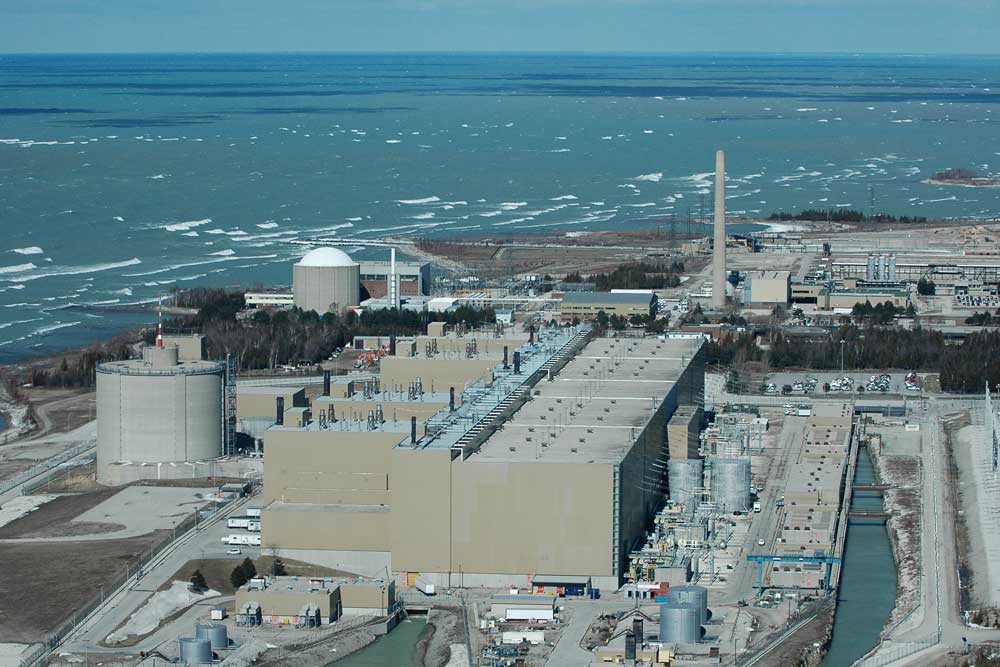
CANDU stands for CANada Deuterium Uranium. It is a heavy-water-moderated reactor that uses deuterium oxide (D₂O) as both moderator and coolant. Heavy water slows neutrons effectively enough that the design can run on natural uranium (0.7% U-235) without enrichment.
CANDU units use pressure tubes (calandria design) rather than one giant pressure vessel for all fuel—each channel can be refueled while the reactor operates.
How It Works
- Fuel bundles sit in horizontal pressure tubes surrounded by cool heavy water moderator in a large calandria vessel.
- Pressurized heavy water flows through the tubes, picks up heat from fuel, and transfers it to light water in steam generators (similar heat-exchange idea to PWRs).
- Light-water steam drives the turbine; the primary heat-transport loop stays heavy water in the tubes.
- Control rods and zone control units (filled with light water or drained) adjust flux shape and power.
- Refueling machines latch onto individual channels and swap fuel bundles without shutting the plant down.
  [Pressure tube + fuel] in [Calandria with D2O moderator]
            ↓ heavy water coolant
      [Steam generator] → light water steam → [Turbine]
Main Systems
| System | Role |
|---|---|
| Calandria | Low-pressure vessel holding bulk moderator |
| Pressure tubes | Contain fuel and high-pressure coolant |
| Steam generators | Boil light water for turbine |
| Refueling machines | Online channel-by-channel fuel exchange |
| Tritium handling | Heavy water can produce tritium; systems manage recovery and emissions |
Fuel is natural UO₂ pellets in bundles. Some operators also use slightly enriched or recovered uranium fuels for flexibility.
Safety Features
- Two independent shutdown systems (e.g., control rods plus liquid poison injection) are standard in CANDU licensing.
- Low-pressure calandria separate from high-pressure tubes—different failure modes than single-vessel PWRs.
- Containment and emergency heat removal via steam generator secondary side or dedicated systems.
- Design emphasis on redundancy and deterministic safety analysis in Canadian and export licensing.
Tritium releases to the environment are monitored; heavy-water leaks are an operational focus because D₂O is costly and activates to tritium over time.
Where It Is Used
- Canada: Darlington, Bruce, Pickering (historical), Point Lepreau.
- Exports: Argentina, Romania, South Korea (historical CANDU builds), India (related PHWR lineage with different details).
Advanced CANDU concepts (e.g., EC6) aim at improved economics and passive features while keeping the heavy-water pressure-tube philosophy.
Tradeoffs
| Advantages | Disadvantages |
|---|---|
| No enrichment required for standard fuel | Heavy water is expensive to produce and maintain |
| Online refueling → high capacity factor | More piping and channels → complex maintenance |
| Fuel flexibility (natural U, SEU, recycled uranium) | Tritium and D₂O leak management |
| Good neutron economy | Larger core per MWe than some PWRs |
Versus PWR: CANDU avoids enrichment but needs heavy water. Versus RBMK: both use pressure tubes, but CANDU uses heavy water moderation (better neutron economy, different safety characteristics) and enclosed calandria, not a large graphite stack with a positive void coefficient in the same way.
Key Takeaways
- CANDU uses heavy water to moderate and allows natural uranium fuel.
- Pressure tubes and online refueling are defining mechanical features.
- Heat is exported through steam generators to a conventional turbine loop.
- The design trades heavy-water cost for fuel-cycle flexibility and high availability.