
Nuclear Fission · Reactor guide
Gas-Cooled Reactor
A reactor family that uses gas, often carbon dioxide or helium, to carry heat away from the core.
- Coolant
- Carbon dioxide, helium, or other gases
- Moderator
- Graphite or none, depending on design
- Fuel
- Uranium, TRISO fuel, or other fuels
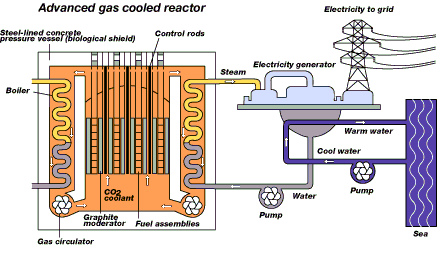
Image from the Virtual Nuclear Tourist
A gas-cooled reactor (GCR) uses a gas—historically carbon dioxide, increasingly helium—to transport heat from the core. The moderator may be graphite (Magnox, Advanced Gas-cooled Reactor) or absent in some high-temperature gas reactor (HTGR) concepts that use a fast or thermal spectrum with specialized fuel.
Gas cooling allows high outlet temperatures, which improves thermodynamic efficiency and can supply industrial heat (hydrogen, process heat) beyond electricity.
How It Works
- Fuel (often uranium metal or oxide, or TRISO particles in modern designs) sits in the core, usually with graphite structures in thermal designs.
- A circulator (compressor/blower) pushes gas through the core, absorbing heat.
- Gas transfers energy to a steam generator or gas turbine (Brayton cycle) downstream.
- Control rods or absorber spheres (in pebble-bed concepts) regulate reactivity.
Magnox / AGR (UK legacy): CO₂ coolant, graphite moderator, on-load refueling in Magnox era; AGR runs hotter with stainless fuel cladding.
HTGR / HTGR pebble bed: Helium coolant, TRISO fuel particles in graphite matrix—fuel and structure can tolerate very high temperatures; strong passive heat rejection by conduction and radiation.
[Core + fuel] ← gas circulator → [Heat exchanger or gas turbine] → electricity / process heat
Main Systems
| System | Role |
|---|---|
| Gas circulators | Move coolant; must seal and handle high pressure in helium plants |
| Graphite structures | Moderation and structural matrix in many designs |
| Steam generators / IHX | Transfer heat to water cycle or another process |
| TRISO fuel (advanced) | Microscopic fuel kernels with ceramic coatings retain fission products |
| Containment / confinement | Helium plants often use prestressed concrete; TRISO provides additional barrier |
Safety Features
- TRISO fuel can retain fission products even at very high temperatures—meltdown in the conventional sense is less central than in LWR fuel.
- High thermal inertia of graphite cores slows transients.
- Passive decay heat removal by conduction, radiation, and natural circulation are design goals in HTGRs.
- Older CO₂ designs had different accident profiles (fire, corrosion, on-load refueling complexity).
Where It Is Used
- United Kingdom: Magnox (mostly retired) and AGR fleet (e.g., Torness)—unique British CO₂ designs.
- Experimental / new build: HTR-PM in China (pebble-bed modules); U.S. X-energy, Kairos, and others developing HTGR and fluoride salt interfaces.
- Historical: Fort St. Vrain (U.S. HTGR) demonstrated helium cooling at scale.
Tradeoffs
| Advantages | Disadvantages |
|---|---|
| High outlet temperature → efficient cycles | Gas has low heat capacity—large flow rates and pressure |
| TRISO can simplify severe accident source term | Graphite oxidation if air ingress (design-dependent) |
| Potential industrial heat / hydrogen | Less operating experience than LWRs globally |
| Brayton cycle possible with helium | Fuel fabrication for TRISO is specialized |
Versus PWR/BWR: higher temperatures but more complex gas handling. Versus molten salt: both pursue high-temperature output; GCR keeps fuel solid in TRISO form.
Key Takeaways
- Gas coolant enables high-temperature operation and diverse power cycles.
- Graphite-moderated CO₂ plants powered much of the UK; helium HTGRs are the modern development focus.
- TRISO fuel is a key safety feature in advanced gas-cooled designs.
- Applications extend beyond electricity to process heat if economics and licensing align.