
Nuclear Fusion
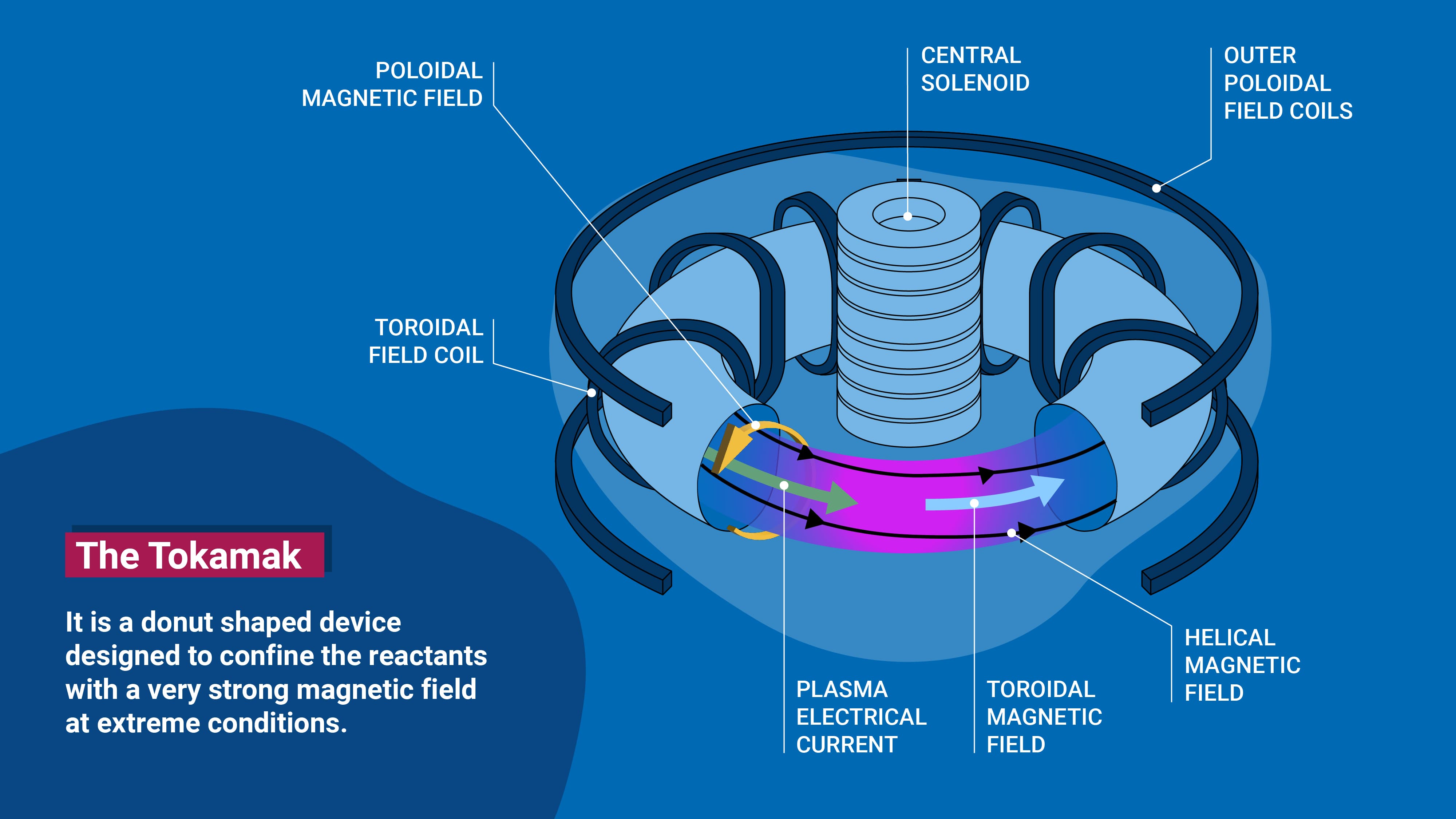
Image by the IAEA
Nuclear fusion is the combining of two light atomic nuclei into a heavier nucleus, with a release of energy when the product is more tightly bound than the reactants. Fusion powers the Sun and most stars. It is also the goal of long-running research into controlled fusion power on Earth.
Fusion is the complementary idea to Nuclear Fission: fission splits heavy nuclei toward the middle of the periodic table; fusion builds up from light nuclei toward the same region of maximum binding energy per nucleon.
This lesson assumes you understand atoms, isotopes, and the basics of nuclear energy from Atoms, Isotopes, and Radioactive Decay. Nuclear Fission is the natural previous step in the Nuclear Reactions series.
Why Light Nuclei Can Fuse
Positively charged nuclei repel each other (Coulomb force). To fuse, they must get close enough for the strong nuclear force to pull them together. That requires very high kinetic energy—extremely high temperature in a gas of ions, or extreme pressure in a star.
When fusion succeeds, the product nucleus often has higher binding energy per nucleon than the reactants. The mass difference is released as energy—again , often carried away by the product nucleus and by radiation such as gamma rays or neutrinos.
A Simple Fusion Reaction
The deuterium–tritium (D–T) reaction is the easiest fusion path to achieve on Earth and is the main focus of most power-plant concepts:
- Deuterium (, D): hydrogen with one proton and one neutron; abundant in seawater.
- Tritium (, T): hydrogen with one proton and two neutrons; radioactive (beta decay, half-life about 12 years); scarce in nature, often bred from lithium in reactor designs.
The outgoing neutron carries much of the energy (about 14 MeV in this reaction), which can be absorbed in a blanket to make heat for turbines.
Other important reactions
| Reaction | Notes |
|---|---|
| D + D → He + n or T + p | No tritium inventory needed; harder than D–T |
| D + He → He + p | Aneutronic (no neutron); rare fuel on Earth |
| p + p → D + e⁺ + ν | First step in the Sun; very slow at solar temperatures |
Fusion reactions are written with the same conservation rules as fission: mass number and charge balance on both sides.
Fusion in the Sun
The Sun is a ball of hot plasma—atoms stripped into nuclei and electrons. In its core, temperature is on the order of 15 million kelvin and pressure is enormous from gravity.
The dominant energy path is the proton–proton chain: hydrogen nuclei (protons) eventually fuse to helium-4, with several steps and long waiting times at solar temperatures. Neutrinos escape from the core; light and heat take thousands to millions of years to diffuse outward before radiating into space.
Stars fuse hydrogen, then (in more massive stars) helium and heavier elements in stages. Iron-peak nuclei are the end of energy-releasing fusion in stars; fusing iron does not release energy.
Fusion vs Fission (Energy and Fuel)
| Fission | Fusion | |
|---|---|---|
| Fuel | Heavy (U, Pu) | Light (H isotopes, Li) |
| Process | Nucleus splits | Nuclei combine |
| Typical waste | Long-lived fission products, actinides | Short-lived activation in structures; helium ash |
| Chain | Neutrons multiply splits | Must confine hot plasma; no runaway like fission bomb in a reactor |
| On Earth today | Commercial power | Research; weapons (H-bomb uses fission trigger) |
Per kilogram of fuel, fusion can release more energy than fission—but only if you actually achieve and sustain the reaction. The Sun succeeds because of mass and gravity; reactors must use other tricks.
Temperature, Plasma, and Confinement
Fusion fuels are not solids or ordinary gases at reaction conditions. They form plasma: ions and free electrons moving at high speed.
Rough requirement for useful D–T fusion: temperatures around 100 million kelvin (about 10 keV average particle energy) and sufficient density and confinement time so enough reactions occur before the plasma loses energy.
Researchers summarize this as the Lawson criterion (product of density, temperature, and confinement time must exceed a threshold). You do not need the formula for a first course—only the idea that hotter, denser, and longer-held plasmas perform better.
Main approaches on Earth
Magnetic confinement (MCF) — Strong magnetic fields guide plasma in a torus (e.g., tokamak, stellarator). ITER in France is the largest international tokamak experiment, aiming to demonstrate net fusion gain at scale.
Inertial confinement (ICF) — Powerful lasers or pulses compress a tiny fuel pellet for nanoseconds. National laboratories use this for physics and stockpile stewardship; NIF reported fusion energy gain milestones in pulsed targets.
Other concepts — Stellarators, field-reversed configurations, magnetized target fusion, and private startups explore different tradeoffs. None yet deliver commercial electricity to the grid.
Why Controlled Fusion Is Hard
- Ignition temperature — Far hotter than any material can touch; plasma must not touch vessel walls (in MCF).
- Confinement — Turbulence and instabilities leak heat and particles; sustaining plasma is delicate.
- Tritium supply — T must be bred in lithium blankets for steady D–T plants.
- Materials — Neutrons from D–T damage vessel walls (activation, embrittlement).
- Energy balance — So far, most devices use more electricity to run than fusion power returned; Q > 1 (more fusion power out than heating power in) is a research milestone, not yet steady commercial operation.
Fusion does not produce meltdown like a fission core losing coolant—if confinement fails, the plasma cools and stops. Challenges are engineering and physics of containment, not a runaway chain reaction in the fission sense.
Fusion Weapons vs Fusion Power
Thermonuclear weapons use a fission primary to compress and heat fusion fuel (often D–T with lithium compounds) for a brief, explosive release. That is unrelated to the steady, controlled conditions a power plant needs.
Fusion power research seeks continuous or pulsed, controlled reactions with safe handling of neutrons and tritium—not a weapon design.
Where Fusion Matters
- Stars and cosmology — Element formation, stellar lifetimes, why the sky shines.
- Future energy — Potential abundant fuel (deuterium from water), no CO₂ from fusion itself, different waste profile than fission.
- Science — Plasmas, materials, superconducting magnets, laser physics.
- Medicine and industry — Neutron sources (some already use small accelerators; fusion neutrons are a possible future tool).
Key Takeaways
- Fusion combines light nuclei into a heavier, more tightly bound nucleus and releases energy.
- The Coulomb barrier requires extreme temperature and confinement; stars use gravity; labs use magnets or lasers.
- D–T is the easiest terrestrial fuel cycle; tritium must usually be bred from lithium.
- The Sun fuses hydrogen to helium via the proton–proton chain at core temperatures and pressures.
- Fusion power is not yet commercial; challenges are plasma confinement, materials, and net energy gain—not a fission-style meltdown.
- Fusion and fission are complementary paths toward the same binding-energy peak near iron.
Practice Quiz
- What is nuclear fusion, in one sentence?
- Why do nuclei repel each other before they can fuse?
- Write the D–T fusion reaction and name the two hydrogen isotopes used.
- What state of matter is fusion fuel in during a reaction?
- Why is tritium often bred rather than mined for fusion plants?
- Name one way stars confine fusion and one way tokamaks try to confine it on Earth.
- If confinement fails in a fusion experiment, why does the reaction stop instead of "running away" like a supercritical fission accident?
Show Answers
- Fusion is the combining of two light nuclei into a heavier nucleus, releasing energy when the product has higher binding energy per nucleon.
- Both nuclei are positively charged; the electromagnetic (Coulomb) force repels them until they are close enough for the strong force to dominate.
- ; reactants are deuterium and tritium.
- Plasma (ionized gas of nuclei and electrons).
- Tritium is rare in nature and radioactive with a short half-life; breeding from lithium under neutron irradiation is the planned steady supply for D–T reactors.
- Stars: gravity and pressure in the core. Tokamaks: strong magnetic fields confining plasma away from walls.
- Fusion needs extreme temperature and confinement; without them, the plasma cools and disperses and reactions cease. There is no neutron chain reaction multiplying splits as in fission.
Next Steps
- Compare energy sources: review Nuclear Fission and Radioactive Decay.
- Explore how engineers harness chain reactions in Nuclear Reactors.