
Radioactive Decay
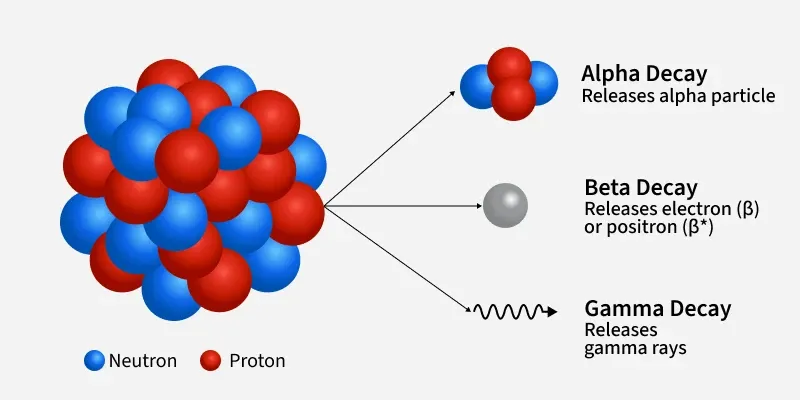
Image by GeeksforGeeks
Not every atomic nucleus lasts forever. Some isotopes are unstable: their nucleus has too much energy or an unfavorable balance of protons and neutrons, so they decay—transform into a different nucleus and emit radiation in the process.
Radioactive decay is how nature rearranges matter at the nuclear level. It powers radiocarbon dating, medical imaging, smoke detectors, and (indirectly) the heat inside Earth. It is also the reason nuclear waste must be handled with care.
This lesson follows Isotopes, where you met stable and radioactive variants. Here we focus on what decays emit, how fast activity falls off, and why energy is released.
Why Some Nuclei Are Unstable
A stable nucleus sits in a favorable balance: the strong nuclear force holds protons and neutrons together, while electromagnetic repulsion pushes protons apart. For each element, only certain neutron counts produce long-lived nuclei—the band of stability on a chart of protons vs neutrons.
Outside that band, nuclei may:
- Have too many or too few neutrons for their proton count
- Be too heavy (many large nuclei are unstable)
- Sit in a high-energy nuclear arrangement that can lower its energy by decaying
Decay moves the nucleus toward a more stable configuration, often a different isotope or a different element. The daughter nucleus may still be radioactive, so decays can chain together (see decay chains below).
Decay is random for a single atom: you cannot predict when one nucleus will decay. For a large sample, however, the average behavior is very predictable—that is where half-life comes in.
The Three Main Types of Radiation
Unstable nuclei commonly emit alpha, beta, or gamma radiation. Each has different properties, different penetrating power, and different effects on the nucleus.
Alpha decay (α)
The nucleus ejects an alpha particle—a cluster of 2 protons and 2 neutrons, identical to a helium-4 nucleus ().
Example: Polonium-210 decaying to lead-206:
- Atomic number drops by 2; mass number drops by 4
- Alpha particles are relatively heavy and slow
- Stopped by a sheet of paper or the outer layer of skin
- Dangerous if swallowed or inhaled—the radiation is absorbed inside the body
Beta decay (β)
A neutron-rich nucleus can convert a neutron into a proton (beta-minus, ), emitting an electron and an antineutrino. A proton-rich nucleus can convert a proton into a neutron (beta-plus, or positron emission).
Beta-minus example (from Isotopes):
Atomic number increases by 1; mass number stays the same (one fewer neutron, one more proton).
- Beta particles are fast electrons (or positrons for )
- Penetrate farther than alpha; stopped by a few millimeters of aluminum or plastic
- Used in many tracers and in radiocarbon dating
Gamma decay (γ)
After alpha or beta decay, the daughter nucleus is sometimes left in an excited state. It releases excess energy as a gamma ray—high-energy electromagnetic radiation, not a piece of matter.
(The asterisk denotes an excited nucleus.)
- No change in proton or neutron count—same isotope, lower energy state
- Gamma rays penetrate deeply; dense materials (lead, thick concrete) are used for shielding
- Often accompany other decay modes
Quick comparison
| Type | What is emitted | Typical shielding | Changes element? |
|---|---|---|---|
| Alpha (α) | Helium nucleus (2p + 2n) | Paper, skin | Yes (Z − 2) |
| Beta (β) | Electron or positron | Plastic, thin metal | Yes (Z ± 1) |
| Gamma (γ) | High-energy photon | Thick lead, concrete | No (same Z, A) |
Note: Neutrons can also be emitted in nuclear reactors and some heavy-nucleus decays; that is central to Nuclear Fission, not ordinary alpha/beta/gamma decay of a single unstable isotope sitting on a shelf.
Writing and Reading Decay Equations
Rules for nuclear equations:
- Mass number A is conserved (total top numbers equal on both sides).
- Atomic number Z is conserved (total bottom numbers equal on both sides).
- Identify the emitted particle (α, β, γ) and the daughter nucleus.
Practice read:
Uranium-238 loses 2 protons and 4 mass units → thorium-234 plus an alpha particle. Check: 238 = 234 + 4 and 92 = 90 + 2.
Half-Life
Half-life () is the time for half of the radioactive atoms in a sample to decay. It is constant for a given isotope and does not depend on how much material you started with.
After one half-life, 50% remains; after two, 25%; after three, 12.5%; after half-lives, of the original activity remains.
| Isotope | Half-life | Decay type (main) | Use or note |
|---|---|---|---|
| Polonium-214 | 164 microseconds | Alpha | Radon decay chain |
| Technetium-99m | 6 hours | Gamma (from metastable state) | Medical imaging |
| Iodine-131 | 8 days | Beta | Thyroid treatment (historical) |
| Carbon-14 | 5,730 years | Beta | Radiocarbon dating |
| Uranium-238 | 4.5 billion years | Alpha | Geologic time, decay chains |
| Potassium-40 | 1.25 billion years | Beta | Internal heating of Earth |
Half-life answers how fast a population of nuclei decays, not which atom goes next. A single atom might decay in a microsecond or survive for billions of years.
Activity
The activity of a sample is how many decays occur per second, measured in becquerels (Bq)—one decay per second—or historically in curies (Ci). Activity depends on how many radioactive atoms are present and their half-life. A short half-life isotope can be very active in a small sample even if the total mass is tiny.
Decay Chains
Heavy unstable nuclei often decay through a series of steps, each producing a new isotope that may also decay, until a stable nucleus is reached.
Uranium-238 series (simplified): decays by alpha and beta steps through radium, radon, polonium, and others, eventually ending at stable lead-206. Radon-222 (a gas) appears in this chain and can accumulate in basements—a reason to test home air in some regions.
Decay chains explain why uranium ore can contain several radioactive elements at once even if only uranium was originally present.
Energy Released in Decay
When an unstable nucleus decays to a more stable one, the products often have slightly less total mass than the parent. The "missing" mass is converted to energy according to Einstein's relation:
That energy appears as the kinetic energy of the emitted alpha or beta particle and as gamma rays. Even a tiny mass difference yields enough energy to ionize atoms and damage biological molecules if radiation is absorbed in living tissue.
This is the same principle behind far larger energy releases in fission and fusion—but ordinary decay involves one nucleus at a time, not a chain reaction.
Radiation in the Real World
Natural background
You are exposed to low-level radiation constantly:
- Cosmic rays from space
- Rocks and soil (uranium, thorium, potassium-40)
- Radon gas from uranium decay chains in the ground
- Carbon-14 and potassium-40 inside your body
Background is usually small compared to occupational limits, but radon is a significant indoor risk in many areas.
Medicine
Short half-life tracers (e.g., technetium-99m) concentrate in organs and emit gamma rays detected by cameras. The isotope decays quickly, limiting long-term dose.
Technology and safety
- Smoke detectors use a tiny amount of americium-241 (alpha) to ionize air; smoke disrupts the current.
- Industrial gauges use sealed sources to measure thickness or density.
- Archaeology uses carbon-14 beta decay (see Isotopes).
Basic protection principles:
- Time — minimize exposure duration
- Distance — radiation intensity often falls quickly with distance
- Shielding — choose material matched to radiation type (paper for alpha, lead for gamma)
Regulated use of sources follows strict licensing; this lesson is not a substitute for radiation safety training.
How Decay Connects to the Rest of the Course
| Topic | Connection |
|---|---|
| Atoms | Nucleus, charge, strong force |
| Isotopes | Which isotopes are stable vs radioactive |
| This lesson | How unstable nuclei transform and emit radiation |
| Nuclear Fission | Heavy nuclei split; neutrons sustain chain reactions |
Fission and fusion are nuclear reactions driven by different physics than spontaneous decay, but all involve rearranging nuclear energy and often produce radioactive products.
Key Takeaways
- Unstable nuclei decay toward more stable configurations, emitting radiation.
- Alpha emits a helium nucleus; beta changes a neutron to a proton (or reverse); gamma releases electromagnetic energy without changing Z or A.
- Half-life describes how quickly a large sample's activity drops; it is fixed per isotope.
- Decay chains link multiple steps from heavy parents to stable daughters (e.g., U-238 → Pb-206).
- Mass–energy conversion () explains why decay releases measurable energy.
- Radioactivity is everywhere in low levels; understanding type and shielding matters for safety.
Practice Quiz
- What is radioactive decay, in one sentence?
- An alpha particle is emitted from . What are the atomic number and mass number of the daughter nucleus?
- How does beta-minus decay change Z and A?
- After two half-lives, what fraction of the original radioactive atoms remains?
- Why are alpha emitters especially hazardous inside the lungs, even though alpha radiation is stopped by paper?
- Carbon-14 decays by beta emission. Why does gamma shielding not stop that decay process in a buried bone sample?
- Name one medical and one natural source of ionizing radiation mentioned in this lesson.
Show Answers
- Radioactive decay is the spontaneous transformation of an unstable atomic nucleus into a more stable nucleus, often by emitting particles or gamma rays.
- Daughter: — Z = 88 − 2 = 86, A = 226 − 4 = 222 (radon-222).
- Beta-minus: Z increases by 1 (new element); A stays the same (neutron → proton, same total nucleons).
- One quarter (25%) remains: .
- Inside the lungs, alpha particles are stopped by tissue and deposit their energy locally, damaging cells. Paper stops alpha outside the body, but internal exposure bypasses that protection.
- Gamma shielding blocks radiation from outside; it does not stop the ongoing nuclear decay inside the sample. Beta decay happens in the nucleus regardless of external shields.
- Examples: Medical — technetium-99m imaging; Natural — radon gas, cosmic rays, potassium-40 in food, or uranium/thorium in rocks (any valid pair from the lesson).
Next Lesson
When you are ready for reactions that multiply nuclear change, continue to Nuclear Fission in the Nuclear Reactions series.