
Atoms
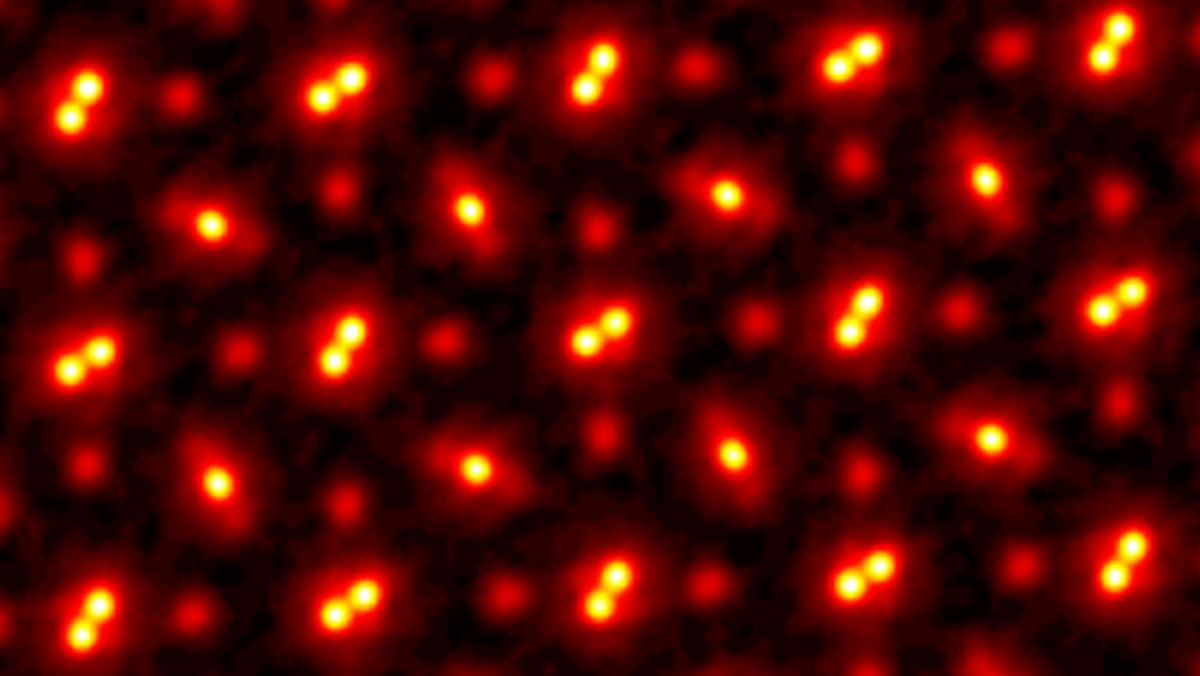
Image shows an electron ptychographic reconstruction of a praseodymium orthoscandate (PrScO3) crystal, zoomed in 100 million times. Cornell University
Everything you can touch, taste, or breathe is built from atoms. Rocks, water, air, and living cells are all collections of atoms arranged in different ways. This lesson gives you a clear picture of what an atom is, what lives inside it, and how atoms connect to form the matter around you.
By the end, you should be able to name the main parts of an atom, explain what makes one element different from another, and describe why some atoms stick together while others do not.
Matter and the Scale of Atoms
Matter is anything that has mass and takes up space. Chemists and physicists often break matter down into levels:
- Atoms — the smallest unit of an element that still behaves like that element
- Molecules — two or more atoms bonded together
- Bulk materials — huge numbers of atoms or molecules together
An atom is incredibly small. If you could blow up a hydrogen atom until the nucleus was the size of a marble sitting on the floor, the electron would orbit roughly the size of a football stadium. Atoms are mostly empty space. The mass is packed into a tiny center; the rest is where electrons move.
That emptiness is not obvious in everyday life because atoms are so numerous and their outer electrons interact strongly with neighboring atoms. You never fall through a chair because electron clouds repel each other when atoms get close.
The Nucleus: Protons and Neutrons
At the center of every atom is the nucleus (plural: nuclei). It contains almost all of the atom's mass in a space about 100,000 times smaller than the whole atom.
Protons
Protons are positively charged particles in the nucleus.
- Charge: +1 (in units of elementary charge, often written e)
- Mass: about 1 atomic mass unit (amu)
- Role: the number of protons defines which element the atom is
The atomic number (Z) is the count of protons. Hydrogen has Z = 1, carbon has Z = 6, gold has Z = 79. Change the proton count and you change the element.
Neutrons
Neutrons sit in the nucleus alongside protons.
- Charge: 0 (neutral)
- Mass: about 1 amu
- Role: add mass and affect nuclear stability; they do not change which element the atom is
The mass number (A) is the total count of protons and neutrons in the nucleus:
For a neutral carbon atom with 6 protons and 6 neutrons, Z = 6 and A = 12. We often write this as carbon-12 or .
Why Doesn't the Nucleus Fly Apart?
Protons are all positive, so they repel each other through the electromagnetic force. Why does the nucleus hold together?
A separate interaction—the strong nuclear force (or strong force)—acts only at very short distances inside the nucleus. It pulls protons and neutrons together more strongly than electromagnetic repulsion pushes protons apart. Without it, no stable nuclei could exist.
Neutrons help in another way: they add attractive strong-force binding without adding more positive charge. That is one reason heavier elements need more neutrons per proton to stay stable.
Note: The strong force is not the same as gravity, magnetism, or ordinary electric attraction. It is a fundamental force of nature, and we explore its consequences further in lessons on isotopes and nuclear reactions.
Electrons
Electrons surround the nucleus.
- Charge: −1
- Mass: about 1/1836 of a proton—so light that for most purposes we treat atomic mass as coming only from the nucleus
- Role: determine chemical behavior—how an atom bonds, conducts electricity, or reacts
In a neutral atom, the number of electrons equals the number of protons, so the positive and negative charges cancel.
Electrons do not orbit the nucleus like planets around the Sun in a simple circle. In modern physics, we describe them in energy levels (shells) and, at a finer level, orbitals—regions where an electron is most likely to be found. For this lesson, three ideas are enough:
- Electrons occupy specific allowed energies, not arbitrary distances.
- Electrons in the outermost shell are called valence electrons; they are the first to participate in chemical bonds.
- Atoms tend toward arrangements where outer shells are more stable (often filled or half-filled), which drives much of chemistry.
You can explore shell filling interactively in the Atom Builder (Bohr) simulator.
Electric Charge
Electric charge is a property of matter that creates electric and magnetic forces. The key rules:
| Particle | Charge |
|---|---|
| Proton | +1 |
| Electron | −1 |
| Neutron | 0 |
Like charges repel; opposite charges attract. Protons attract electrons. Protons repel other protons unless the strong force overcomes that repulsion in the nucleus.
Charge is conserved: it is not created or destroyed in ordinary chemical or physical processes. If an atom loses one electron, something else must gain it (or the environment must account for the imbalance).
Ions
When an atom gains or loses electrons, it becomes an ion:
- Cation — lost electrons, net positive charge (e.g., Na⁺)
- Anion — gained electrons, net negative charge (e.g., Cl⁻)
Ions matter for salts, batteries, nerve signals, and many geological processes. The nucleus (protons and neutrons) is unchanged when an ion forms—only the electron count changes.
Elements
An element is a substance made of atoms that all have the same number of protons. Each element has a name (carbon), a symbol (C), and an atomic number (Z).
There are just over 90 naturally occurring elements, plus more made in laboratories. Every material in the universe is either a pure element or a combination of elements.
The periodic table arranges elements by atomic number and reveals patterns in chemical behavior. After this lesson, continue with The Periodic Table to see how rows, columns, and blocks encode those patterns.
Atomic Mass on the Table
The number shown for each element on the periodic table is usually the average atomic mass of all stable isotopes in their natural proportions on Earth—not the mass number of a single isotope. For example, chlorine on the table is about 35.45 amu because natural chlorine is a mix of chlorine-35 and chlorine-37.
Isotopes
Atoms of the same element can have different numbers of neutrons. These variants are isotopes.
- Same atomic number (Z) — same element
- Different mass number (A) — different neutron count
Examples for carbon (Z = 6):
| Isotope | Protons | Neutrons | A |
|---|---|---|---|
| Carbon-12 | 6 | 6 | 12 |
| Carbon-13 | 6 | 7 | 13 |
| Carbon-14 | 6 | 8 | 14 |
All three are carbon. Carbon-12 and carbon-13 are stable. Carbon-14 is radioactive—it decays over time, which makes it useful for dating old organic material.
Isotopes of the same element behave almost identically in chemistry (same electrons, same bonding), but they can differ in nuclear properties (stability, radiation, use in reactors or medicine). See the dedicated Isotopes lesson for stability, notation, and real-world applications.
Isobars
Isobars are atoms (or nuclei) with the same mass number A but different atomic numbers Z—different elements.
Example: (calcium-40, 20 protons + 20 neutrons) and (argon-40, 18 protons + 22 neutrons) are isobars. Both have A = 40, but they are different elements with different chemistry.
Do not confuse:
| Term | Same across variants | Different across variants |
|---|---|---|
| Isotope | Element (Z) | Neutron count, A |
| Isobar | Mass number (A) | Element (Z), neutron count |
From Atoms to Molecules
Most substances are not single atoms. They are molecules or extended structures built from bonded atoms.
- Molecule — a group of two or more atoms held together by chemical bonds (e.g., H₂O, O₂, CO₂)
- Compound — a substance made of two or more different elements in fixed proportions (water is always H₂O)
- Mixture — substances physically combined but not chemically bonded (salt dissolved in water; air)
A chemical bond is a lasting attraction between atoms that lowers energy compared with separated atoms. Bonds form because atoms can reach more stable electron arrangements, often by sharing or transferring valence electrons.
Main Types of Bonds (Overview)
Ionic bonding — one atom transfers electrons to another, forming oppositely charged ions that attract (e.g., sodium chloride, NaCl: Na loses one electron, Cl gains it).
Covalent bonding — atoms share pairs of electrons (e.g., H₂, O₂, most organic molecules).
Metallic bonding — metal atoms release valence electrons into a shared "sea" that holds the lattice together (explains conductivity and malleability of metals).
Hydrogen bonding — a weaker attraction involving hydrogen attached to a highly electronegative atom (N, O, F); important for water's properties and DNA's structure.
This lesson names the ideas; later chemistry lessons go deeper into bond polarity, geometry, and energy.
Putting It Together: A Neutral Oxygen Atom
Oxygen is element 8:
- 8 protons → Z = 8, defines oxygen
- 8 neutrons in the most common isotope → A = 16 (oxygen-16)
- 8 electrons in a neutral atom → zero net charge
- 6 valence electrons in the outer shell → oxygen readily forms bonds (e.g., two covalent bonds in water)
The nucleus (8 protons + 8 neutrons) accounts for nearly all the mass. The electrons determine that oxygen is a reactive gas that supports combustion and makes up about 21% of Earth's atmosphere.
Key Takeaways
- Atoms have a dense nucleus (protons + neutrons) and lighter electrons around it; atoms are mostly empty space.
- Protons set the element (atomic number Z); neutrons change mass number A without changing the element.
- The strong nuclear force binds the nucleus; electric charge governs electrons and ionic attraction.
- Neutral atoms have equal protons and electrons; ions form when that balance changes.
- Isotopes share Z but differ in neutrons; isobars share A but differ in Z.
- Chemical bonds link atoms into molecules and compounds; valence electrons are central to how that happens.
Practice Quiz
Test your understanding:
- Which particle determines which element an atom is?
- What force holds protons and neutrons together in the nucleus despite proton–proton repulsion?
- An atom has 17 protons and 18 neutrons. What are its atomic number and mass number?
- How do isotopes of the same element differ? How do they stay the same?
- and are isobars. What do they have in common, and what is different?
- A fluorine atom (9 protons) gains one electron. Is it neutral? What is it called?
- Why do valence electrons matter more than inner electrons for chemical bonding?
Show Answers
- Protons — the atomic number (proton count) defines the element.
- The strong nuclear force (strong force) at very short range in the nucleus.
- Atomic number 17; mass number 35 (17 + 18).
- They differ in neutron count (and mass number A). They are the same in proton count (Z) and therefore the same element.
- Both have mass number 14 (same total protons + neutrons). They differ in atomic number — nitrogen has 7 protons, carbon has 6 — so they are different elements.
- It is not neutral; it has a net charge of −1. It is a fluoride anion (F⁻), an anion.
- Valence electrons are in the outermost shell, so they are the first involved in sharing or transferring charge when atoms bond; inner electrons are held more tightly and usually stay on their atom during ordinary chemistry.
Next Lesson
Continue to The Periodic Table to see how all the elements are organized—and what that organization predicts about atomic behavior.