
Isotopes
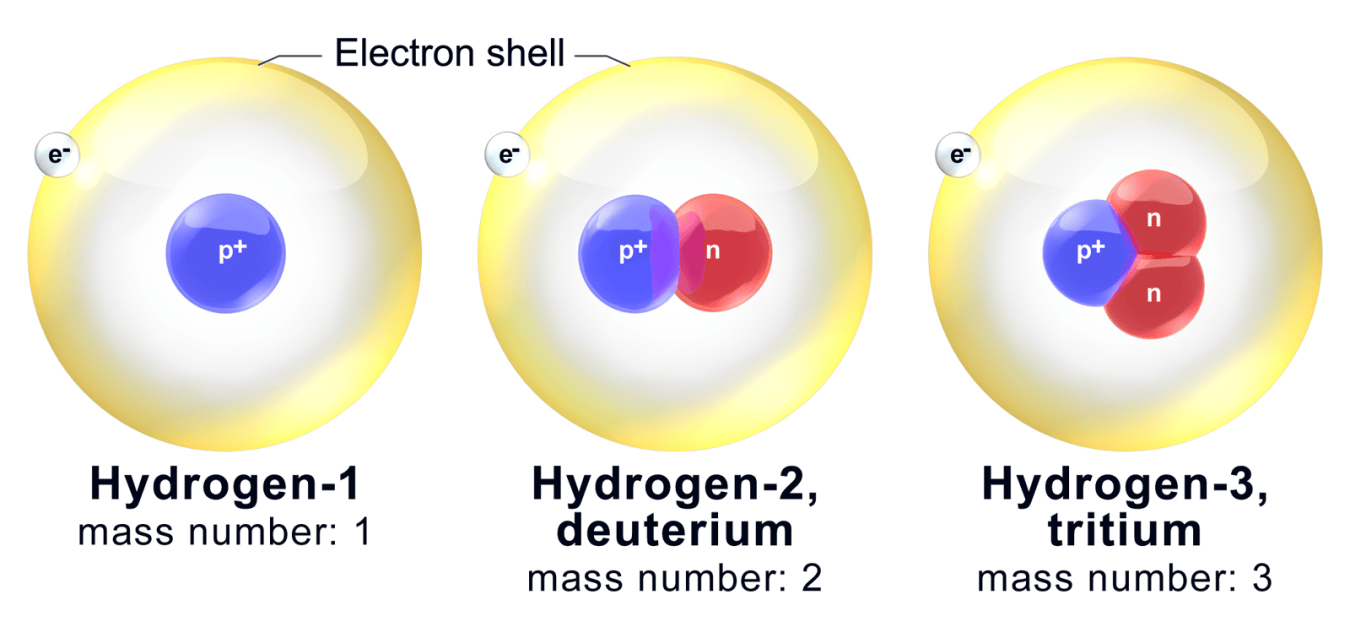
Image courtesy of Wikimedia commons (shared by US DOE).
Every element comes in variants. Atoms of the same element share an atomic number—the same number of protons. But they can carry different numbers of neutrons. These variants are called isotopes.
Isotopes range from perfectly stable to radioactive, from clinically useful to cosmically abundant. Understanding them explains decimal atomic masses on the periodic table, radiocarbon dating, nuclear medicine, reactor fuel, and much of environmental science.
This lesson builds on Atoms and The Periodic Table. Those lessons introduced isotopes in passing; here we go deeper on notation, abundance, stability, and applications.
Protons Define the Element
The number of protons determines what element an atom is. Carbon always has 6 protons. Uranium always has 92 protons. If the proton count changes, the atom becomes a different element—not a new isotope.
The atomic number Z is the proton count. Every isotope of carbon has Z = 6.
Neutrons Define the Isotope
Neutrons add mass and strongly affect nuclear stability. They do not change which element the atom is.
Carbon-12 and carbon-14 are both carbon because they both have 6 protons. Carbon-12 has 6 neutrons; carbon-14 has 8.
The mass number A is protons plus neutrons:
Naming isotopes
The everyday name combines the element with the mass number:
- Carbon-12: 6 protons + 6 neutrons → A = 12
- Carbon-14: 6 protons + 8 neutrons → A = 14
- Uranium-235: 92 protons + 143 neutrons → A = 235
Nuclide notation
Scientists also write isotopes with the element symbol and both A and Z:
Examples:
- — carbon-12
- — carbon-14
- — uranium-235
The top number is always the mass number A; the bottom number is the atomic number Z. If you know Z and the element symbol, you can find the neutron count: neutrons = A − Z.
Same Element, Same Chemistry—Different Nucleus
Isotopes of an element have the same number of protons and electrons (in neutral atoms), so they occupy the same place on the periodic table and behave almost identically in chemistry. Water made with hydrogen-1 and water made with deuterium (hydrogen-2) both act like water.
Where isotopes differ is in the nucleus: mass, stability, and nuclear reactions. Radiation, half-life, and reactor behavior depend on neutron count—not on how an atom bonds in a molecule.
That split is one of the most useful ideas in the whole series: electrons for chemistry, nucleus for nuclear physics.
Stable and Radioactive Isotopes
For each element, only certain combinations of protons and neutrons are stable—they do not spontaneously change. Others are unstable (radioactive) and eventually decay, emitting particles or energy until the nucleus reaches a more stable arrangement.
Stability is not random. Very light elements often do best with roughly equal protons and neutrons. Heavier elements need more neutrons than protons to offset proton–proton repulsion in the nucleus. Too few or too many neutrons for a given proton count tends toward instability. A full chart of stable combinations (the "band of stability") belongs in a later nuclear lesson; for now, remember that neutron count must "fit" the proton count for a long-lived nucleus.
Radioactive isotopes are not all alike. Some decay in fractions of a second; others last billions of years.
Examples: stable pairs
| Isotope | Z | Neutrons | A | Notes |
|---|---|---|---|---|
| Hydrogen-1 (protium) | 1 | 0 | 1 | Most common hydrogen |
| Hydrogen-2 (deuterium) | 1 | 1 | 2 | Stable; used in reactors and NMR |
| Chlorine-35 | 17 | 18 | 35 | About 75% of natural Cl |
| Chlorine-37 | 17 | 20 | 37 | About 25% of natural Cl |
Examples: radioactive isotopes
| Isotope | Z | Neutrons | A | Notes |
|---|---|---|---|---|
| Hydrogen-3 (tritium) | 1 | 2 | 3 | Radioactive; used in fusion research |
| Carbon-14 | 6 | 8 | 14 | Radiocarbon dating |
| Uranium-235 | 92 | 143 | 235 | Fissile reactor fuel |
| Uranium-238 | 92 | 146 | 238 | More abundant; different nuclear properties |
Uranium-235 and uranium-238 are both uranium (Z = 92) with different neutron counts—different isotopes, different roles in nuclear technology.
Why Atomic Masses on the Table Are Decimals
On The Periodic Table, chlorine is listed near 35.45 amu, not 35 or 37. That is because natural chlorine is a mixture of isotopes. Roughly three quarters is chlorine-35 and one quarter is chlorine-37. The tabulated value is a weighted average of those isotopic masses, weighted by how common each isotope is on Earth.
The same logic applies to carbon (≈ 12.01 amu), copper, and most elements: the table reports average atomic mass of the natural mix, not the mass number of a single isotope.
In the lab, a mass spectrometer can separate isotopes by mass and measure how much of each is present—useful in geology, forensics, and nuclear safeguards.
Isotopes vs Isobars
Do not confuse isotopes with isobars (introduced in Atoms):
| Term | Same | Different |
|---|---|---|
| Isotopes | Element (Z), chemistry | Neutron count, A |
| Isobars | Mass number (A) | Element (Z), neutron count |
and are isobars (both A = 14), not isotopes—they are different elements. Carbon-12 and carbon-14 are isotopes (both Z = 6), not isobars.
Example: Carbon-14
Carbon-14 is a radioactive isotope with 6 protons and 8 neutrons. It forms naturally in the upper atmosphere when cosmic-ray neutrons strike nitrogen-14, producing carbon-14 and a proton:
Cosmic rays maintain a roughly steady concentration of carbon-14 in the atmosphere. It mixes into CO₂ and enters living plants and animals through photosynthesis and the food chain.
While an organism is alive, it exchanges carbon with the environment and keeps about the same ratio of carbon-14 to stable carbon-12 as the air. When it dies, that exchange stops and carbon-14 decays with no replacement.
Radiocarbon Dating
Carbon-14 undergoes beta decay, transforming into nitrogen-14:
The nucleus emits a beta particle (an electron from the nuclear process) and an antineutrino . You do not need to memorize the antineutrino for introductory chemistry; it is there because energy and momentum must be conserved in full physics treatments.
With a half-life of about 5,730 years, carbon-14 is useful for dating organic materials up to roughly 50,000 years old. By measuring the ratio of carbon-14 to carbon-12 in a sample, scientists estimate how long ago the organism stopped exchanging carbon with the biosphere.
For how decay works in general—alpha and gamma radiation, decay chains, and more—see Radioactive Decay.
Why Isotopes Matter
Isotopes show up throughout science and technology:
- Archaeology and Earth science — radiocarbon and other isotopic clocks date bones, sediments, and ice cores.
- Medicine — radioactive tracers (e.g., technetium-99m) image organs; stable isotopes can label molecules for metabolic studies.
- Nuclear energy — uranium-235 sustains fission chain reactions in many reactors; uranium-238 is more abundant and behaves differently.
- Climate science — ratios of carbon, oxygen, and hydrogen isotopes in ice and water reveal past temperatures and circulation.
- Astrophysics — isotopic abundances in stars and meteorites trace how elements formed and mixed in the early solar system.
The key idea is simple: the element is set by protons, but the isotope—and much of nuclear behavior—is shaped by neutrons.
Key Takeaways
- Isotopes share atomic number Z (same element) but differ in neutron count and mass number A.
- Write isotopes as carbon-14 or ; neutrons = A − Z.
- Chemistry is nearly the same for all isotopes of an element; nuclear properties differ.
- Natural elements often mix stable isotopes; periodic-table masses are weighted averages.
- Radioactive isotopes decay toward stability; half-life and radiation type depend on the nucleus.
- Isobars share A but not Z—different elements, not isotopes of each other.
Practice Quiz
- What defines the element, and what defines the isotope?
- How many neutrons are in ?
- Why do isotopes of the same element have similar chemical behavior?
- Natural chlorine has an average atomic mass near 35.45 amu. Why is that not a whole number?
- and are isotopes. and are isobars. What is the difference?
- After a tree dies, its carbon-14 content decreases. Why can that be used to estimate age?
- Uranium-235 and uranium-238 have the same chemistry as uranium. Why are they treated differently in nuclear engineering?
Show Answers
- Protons (atomic number Z) define the element. Neutrons (and thus mass number A) define the isotope.
- 20 neutrons: A − Z = 37 − 17 = 20.
- Neutral isotopes have the same proton and electron count, so the same electron structure and bonding behavior; only the nucleus differs.
- Chlorine in nature is a mixture of isotopes (mainly Cl-35 and Cl-37). 35.45 amu is a weighted average, not the mass number of one atom.
- Isotopes: same Z, different A (same element, different neutrons). Isobars: same A, different Z (different elements, e.g., C-14 vs N-14).
- While alive, the tree exchanges carbon with the atmosphere and keeps a steady C-14 to C-12 ratio. After death, no new C-14 is taken in, but C-14 decays with a known half-life, so the ratio falls and indicates elapsed time.
- They share chemistry (same Z) but differ in nuclear stability and reactions—especially fission: U-235 is fissile with slow neutrons; U-238 is not used the same way in standard thermal reactors.
Next Lesson
Continue to Radioactive Decay for how unstable nuclei transform—and what alpha, beta, and gamma radiation mean in practice.