
Nuclear Fission · Reactor guide
RBMK Reactor
A Soviet graphite-moderated, light-water-cooled pressure-tube reactor design.
- Coolant
- Light water
- Moderator
- Graphite
- Fuel
- Enriched uranium dioxide
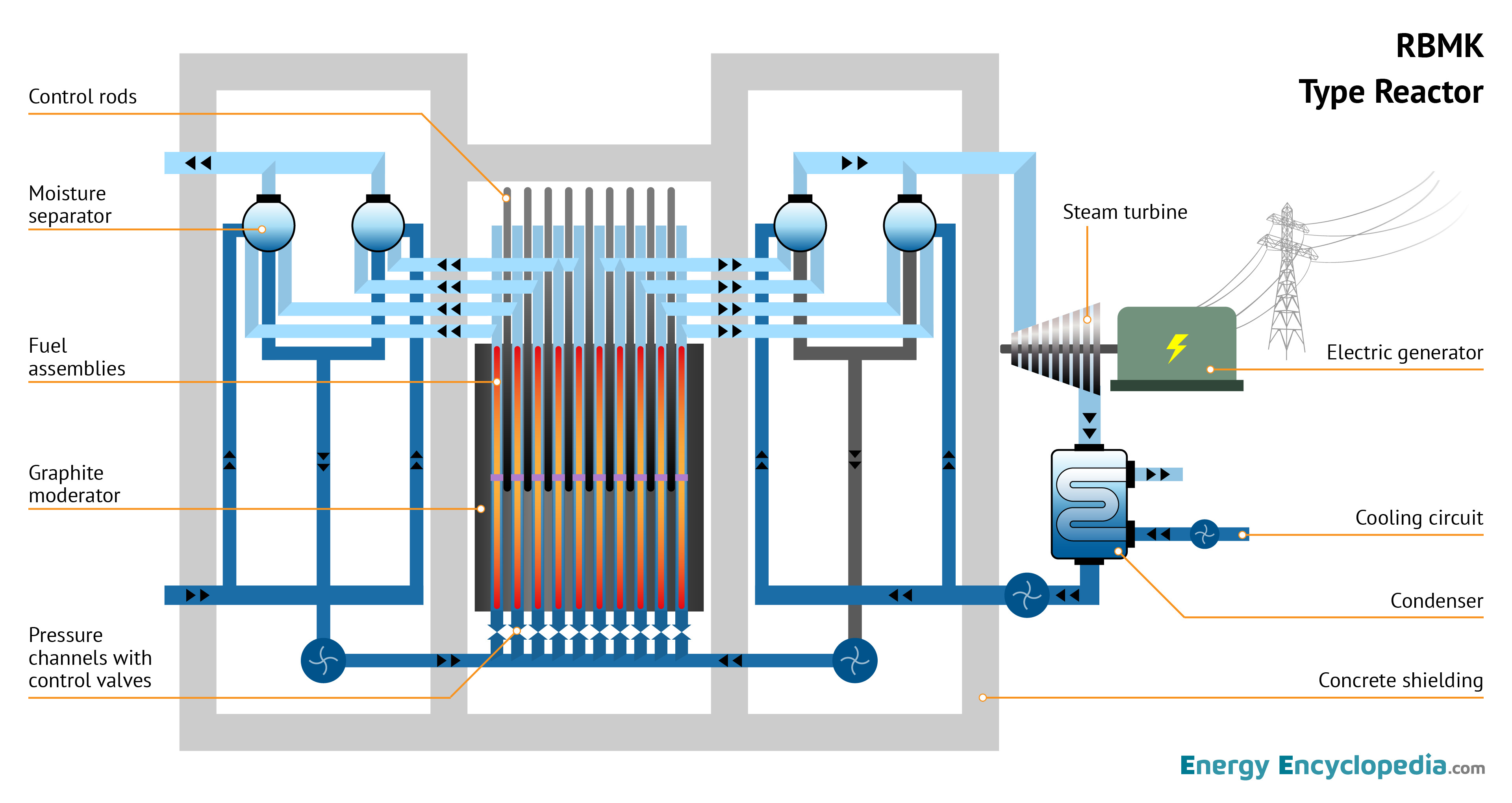
RBMK (Reaktor Bolshoy Moshchnosti Kanalnyy—high-power channel-type reactor) is a Soviet-era design that uses graphite as the moderator and light water flowing through pressure tubes as coolant. It was built to produce plutonium and electricity at scale using a pressure-tube layout similar in spirit to CANDU, but with very different physics and safety properties.
The design is historically associated with the 1986 Chernobyl Unit 4 accident. Understanding RBMK is essential for nuclear safety history—not as a template for new builds, but as a lesson in how design, operations, and regulation interact.
How It Works
- Graphite blocks form a large moderator stack; fuel channels pass through it vertically.
- Light water enters each channel, boils as it rises past fuel, and steam goes to separators and then the turbine (direct cycle like a BWR in that respect).
- Control rods move slowly in some designs; voids (steam) in channels affect reactivity strongly.
- Emergency protection systems were modified after Chernobyl (more absorbers, faster rods, operational limits).
  [Graphite moderator block] with vertical [fuel + water channels]
            ↓ boiling coolant
         steam → [Turbine]
Distinctive Physics
| Feature | Implication |
|---|---|
| Graphite moderator | Water can boil in channels without losing all moderation (unlike light-water-moderated BWR/PWR) |
| Positive void coefficient (in original designs) | More steam in channels can increase reactivity under some conditions |
| Large core, low power density | Slow response; spatial power oscillations possible |
| Control rod design (historical) | Some rod tips displaced coolant before absorbing neutrons—local positive effect on insertion |
These traits made operating within approved procedures critical. The Chernobyl Unit 4 test violated safety limits and combined with the above characteristics to produce a power excursion and steam explosion, then graphite fire.
Main Systems
| System | Role |
|---|---|
| Graphite stack | Moderates neutrons; large inventory, combustible at high temperature in air |
| Pressure tubes + fuel channels | Coolant flow and fuel location |
| Steam separators / drums | Dry steam for turbine |
| Containment | Not a full Western-style pressure containment in early RBMK plants—major difference vs PWR/BWR |
| Emergency cooling | Added and improved post-accident |
Safety Lessons
Chernobyl drove global changes:
- Recognition that positive reactivity feedback and slow safety systems are unacceptable in power reactors.
- Importance of safety culture, independent regulation, and no disabling of interlocks.
- Containment and passive features became stricter for new designs worldwide.
Remaining RBMK units received safety upgrades (control rods, absorbers, operational limits). Most have been shut down; a few were licensed into the 2010s–2020s with heavy modifications in Ukraine and Russia.
Where It Was Used
- Former Soviet Union: Chernobyl, Leningrad, Kursk, Smolensk, Ignalina (Lithuania), and others.
- No new RBMK construction internationally; the design is a legacy fleet.
Tradeoffs (Historical)
| Stated advantages (Soviet era) | Fundamental drawbacks |
|---|---|
| Could be refueled online | Positive void coefficient in original designs |
| Large components built on site | No robust containment on early plants |
| Graphite + boiling water → large thermal output | Complex, accident-sensitive reactivity control |
Modern reactor programs emphasize negative feedback, containment, and passive safety—the opposite emphasis from uncorrected RBMK operation.
Key Takeaways
- RBMK = graphite-moderated, water-cooled, pressure-tube reactor with direct steam to turbine.
- Its void coefficient and control systems made certain transients dangerously unstable.
- Chernobyl reshaped international safety requirements and ended RBMK as a viable export product.
- Studying RBMK clarifies why design certification, containment, and procedure matter as much as fuel choice.