
The Periodic Table
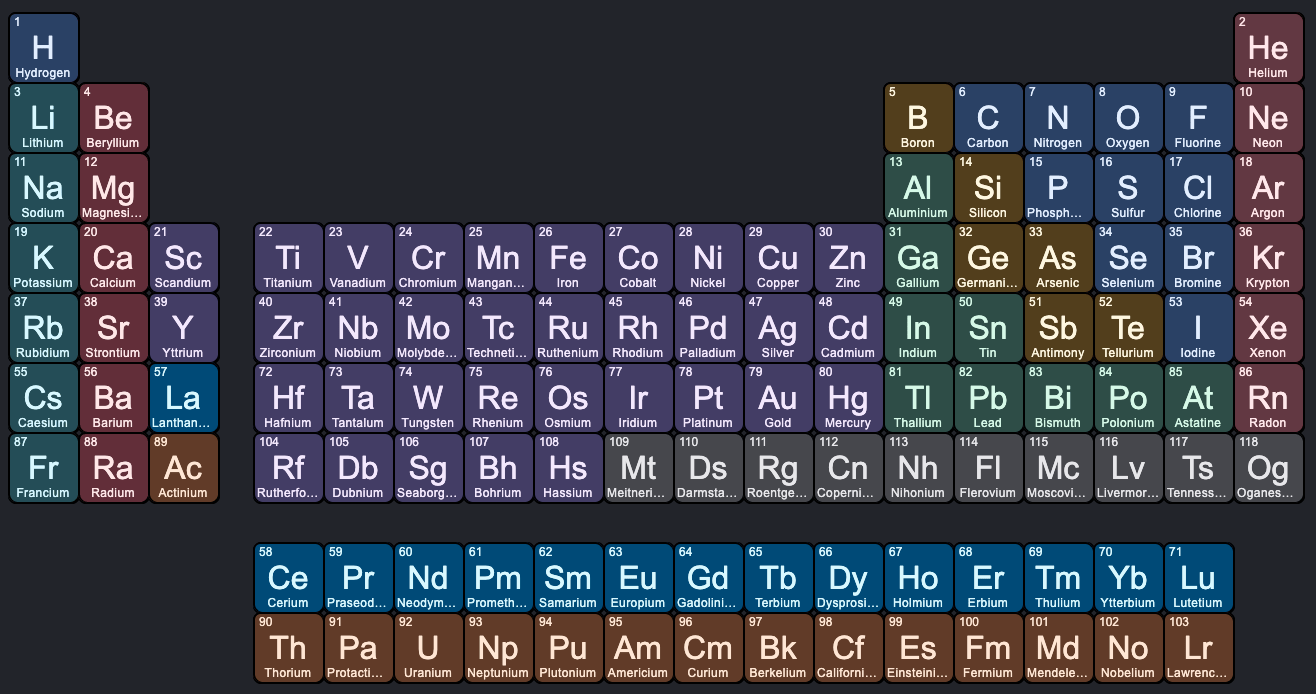
If you know how to read the periodic table, you can predict a great deal about an element before you ever run an experiment. The table is not an arbitrary list of names—it is a map of atomic number, electron structure, and recurring chemical behavior.
This lesson assumes you are comfortable with protons, electrons, and valence electrons from Atoms. Here we focus on how those ideas are encoded in rows, columns, and blocks—and what trends follow when you move across the table or down a group.
Why the Table Exists
By the 1860s, chemists knew dozens of elements and noticed that some groups repeated similar properties at regular intervals—periodicity. Dmitri Mendeleev (and others working independently) arranged elements by increasing mass and aligned families with similar chemistry.
Mendeleev's table was powerful because it had gaps: he left empty spaces for elements not yet discovered and predicted their properties. When gallium and germanium were found, they fit those slots—strong evidence that the arrangement reflected something deep about matter.
Today we order elements by atomic number (proton count), not by mass alone. That fix resolved a few cases where atomic mass order disagreed with chemical behavior (for example, tellurium and iodine). Atomic number is the fundamental index; the table's shape follows from how electrons fill energy levels around the nucleus.
The Basic Layout
Each element has one box (or one cell in extended layouts). A standard box usually shows:
| Label | Meaning |
|---|---|
| Symbol | Abbreviation (H, Fe, U) |
| Atomic number Z | Number of protons |
| Name | Full element name |
| Atomic mass | Weighted average mass of natural isotopes (in amu) |
Example: Carbon — symbol C, Z = 6, atomic mass ≈ 12.01 amu. The mass is not a whole number because natural carbon mixes carbon-12 and carbon-13 (and trace carbon-14).
Rows: Periods
A period is a horizontal row. There are seven periods in the standard table.
- Elements in the same period have the same number of electron shells (principal energy levels in use).
- As you move left to right across a period, atomic number increases by one proton and (in neutral atoms) one more electron.
- Each step to the right typically adds electrons to the outermost shell or to subshells at similar energy—until the shell is full and a new period begins below.
Period 1 has only hydrogen and helium. Period 2 runs from lithium to neon. The bottom two rows—the lanthanides and actinides—are usually shown separately to keep the main table compact, but they belong in periods 6 and 7.
Columns: Groups
A group (or family) is a vertical column. The modern IUPAC numbering runs 1–18 from left to right.
- Elements in the same group have the same number of valence electrons (for main-group elements).
- That shared valence pattern produces similar chemistry: sodium and potassium both react vigorously with water; fluorine and chlorine both form salts with sodium.
Older North American labels (1A, 2A, … 8A) and Roman numerals (IA, IIA) still appear in textbooks; the lesson Atoms and many charts use the 1–18 system.
Key idea: Period tells you how many shells; group (for main-group elements) tells you how many valence electrons.
Blocks: s, p, d, and f
The table can be divided into four blocks, named for the subshell being filled in that region:
| Block | Where on table | Subshell filled | Notes |
|---|---|---|---|
| s | Groups 1–2 (and He) | s | Highly reactive metals (Group 1), alkaline earths (Group 2) |
| p | Groups 13–18 (right side) | p | Includes metals, metalloids, nonmetals, noble gases |
| d | Center (transition metals) | d | Groups 3–12; variable oxidation states, colored compounds, catalysts |
| f | Lanthanides & actinides | f | Inner transition metals; similar chemistry within each series |
You do not need to memorize every electron configuration in a first pass. The block picture explains why the center and the two bottom rows look different from the main rectangle: different subshells are filling.
Metals, Nonmetals, and Metalloids
The table has a broad metal / nonmetal divide.
Metals (left and center)
- Shiny solids (at room temperature; mercury is a liquid metal)
- Good conductors of heat and electricity
- Malleable (hammered into sheets) and ductile (drawn into wire)
- Tend to lose valence electrons and form cations (e.g., Mg²⁺)
Most elements are metals. They occupy the left side, the center (transition metals), and the f-block.
Nonmetals (upper right)
- Often dull in appearance; poor conductors as solids
- Tend to gain or share electrons in compounds
- Include essential life elements: carbon, nitrogen, oxygen, phosphorus, sulfur
Hydrogen is placed in Group 1 but behaves as a nonmetal in many reactions—a deliberate compromise on the chart.
Metalloids (staircase)
Along a diagonal "staircase" between metals and nonmetals sit the metalloids (or semimetals): boron, silicon, germanium, arsenic, antimony, tellurium, and sometimes polonium.
- Properties between metals and nonmetals
- Semiconductors—conductivity between insulators and metals; critical for electronics (silicon chips)
The staircase is a useful rule of thumb, not a sharp law: properties change gradually across the boundary.
Important Groups to Recognize
These families appear constantly in chemistry, biology, and nuclear topics.
Group 1: Alkali metals (Li → Fr)
- One valence electron
- Very reactive: react with water to form hydroxides and hydrogen gas
- Soft, low density, silvery
- Examples: sodium (Na), potassium (K) — essential for nerves and fluids in biology
Never handle large samples of reactive alkali metals without proper training.
Group 2: Alkaline earth metals (Be → Ra)
- Two valence electrons
- Reactive, but less so than Group 1
- Examples: magnesium (Mg) in chlorophyll-related chemistry, calcium (Ca) in bones and shells
Group 17: Halogens (F → At)
- Seven valence electrons; need one more for a filled outer shell of eight
- Very reactive nonmetals; form salts with metals
- Examples: chlorine (Cl) in disinfectants, iodine (I) in nutrition and medicine
Group 18: Noble gases (He → Og)
- Full valence shell (eight electrons, or two for helium)
- Largely unreactive under normal conditions—stable electron arrangements
- Examples: neon (Ne) in signs, argon (Ar) in welding shields, helium (He) in balloons and cryogenics
Because noble gases are stable, they were once called "inert gases." Heavier noble gases can form compounds under extreme conditions, but the label "noble" still fits their usual chemistry.
Other notable regions
- Transition metals (Groups 3–12): Multiple oxidation states, often colored ions, important catalysts (iron, nickel, platinum).
- Lanthanides (rare earths): Similar chemistry, used in magnets, lasers, and phosphors.
- Actinides: Includes uranium (U) and plutonium (Pu)—central to nuclear energy and weapons; all actinides are radioactive.
How Position Connects to Atoms
Recall from Atoms:
- Atomic number Z = protons = electrons in a neutral atom
- Valence electrons drive bonding and reactivity
- Mass number A differs between isotopes; the table's atomic mass is an average
The periodic table is the bridge:
- Find Z → you know the element and its proton count.
- Find the group (main group) → you know valence electron count (with the usual pattern).
- Find the period → you know how many shells are occupied.
- Read atomic mass → estimate molar quantities in chemistry; remember it is an isotope average (see Isotopes).
Example: Sulfur (S) — Group 16, Period 3. Z = 16, so 16 electrons in a neutral atom; six valence electrons (same pattern as oxygen in Group 16); three shells. You can predict that sulfur forms compounds where it shares or gains electrons to reach a stable count, similar to oxygen but with a larger atom.
Periodic Trends
Properties change in predictable directions as atomic number increases. Trends are most reliable for main-group elements; transition metals show more exceptions.
Atomic radius (size)
Across a period (left → right): size decreases.
More protons pull electrons closer; added electrons enter the same shell, so shielding does not increase much.
Down a group (top → bottom): size increases.
Each step adds a new electron shell; inner electrons shield outer ones from the nucleus.
Ionization energy
Ionization energy is the energy required to remove an electron from a neutral atom in the gas phase.
- Across a period: generally increases (electrons held more tightly).
- Down a group: generally decreases (outer electrons farther from nucleus, easier to remove).
That is why alkali metals (low ionization energy) give up one electron easily and halogens (high ionization energy) do not.
Electronegativity
Electronegativity measures how strongly an atom attracts shared electrons in a bond.
- Across a period: increases (nonmetals pull harder on electrons).
- Down a group: decreases.
Fluorine is the most electronegative element. A large electronegativity difference between two atoms suggests ionic character in the bond; similar values suggest covalent sharing.
Metallic character
Metallic character (tendency to behave like a metal: lose electrons, conduct) follows the opposite pattern of electronegativity in many ways:
- Across a period: metallic character decreases.
- Down a group: metallic character increases.
At the bottom-left, francium is the most metallic in character; at the top-right, fluorine is among the least metallic.
Summary diagram (main-group trends)
        Atomic radius ↑          Metallic character ↑
        Ionization energy ↓      Electronegativity ↓
                    ↑
                    |
    ←───────────────┼───────────────→
    (across period) |   Ionization energy ↑
                    |   Electronegativity ↑
                    |   Atomic radius ↓
                    ↓
        (down a group — opposite for most trends above)
Always state which direction you are moving on the table when you use a trend. "Increases across a period" and "increases down a group" are different claims.
Reading Real Problems with the Table
Example 1 — Compare sodium and chlorine
Na: Group 1, Period 3 — one valence electron, low ionization energy, forms Na⁺.
Cl: Group 17, Period 3 — seven valence electrons, high electronegativity, forms Cl⁻.
Same period (same number of shells), opposite sides (metal vs nonmetal) → they form ionic sodium chloride (table salt).
Example 2 — Compare carbon and silicon
Both Group 14, four valence electrons. Carbon is Period 2, silicon Period 3 → silicon is larger and less electronegative. Both form covalent networks (diamond, quartz), but silicon's chemistry is slower and more "metallic" in character—consistent with position below carbon.
Example 3 — Noble gas between reactive neighbors
Neon sits between fluorine (very reactive) and sodium (very reactive) in Period 2, but neon itself barely reacts—because its valence shell is full.
Common Questions
Why is hydrogen in Group 1?
It has one valence electron like lithium and sodium, but it is a tiny nonmetal. The table has one slot for hydrogen; Group 1 is the conventional home.
Why are the f-block elements pulled out?
Fourteen f-electrons per series would make the main table very wide. The numbering of groups still accounts for them in the full 1–18 system.
Can I predict every property from position?
Position gives strong hints about valence electrons and trends, not exact numbers. Laboratory data and quantum calculations still matter for precise ionization energies, bond lengths, and colors.
Key Takeaways
- Elements are ordered by atomic number; the table's structure reflects electron shells and subshells (periods and blocks).
- Groups align elements with the same valence electron count (main group) and similar chemistry.
- Metals, nonmetals, and metalloids occupy different regions; the staircase marks the boundary.
- Recognizing alkali metals, halogens, and noble gases explains a large fraction of introductory reactions.
- Trends (size, ionization energy, electronegativity, metallic character) follow from nuclear charge and shell structure when you move across a period or down a group.
- The table connects to Atoms (structure) and Isotopes (why atomic masses are averages).
Practice Quiz
- What quantity determines the order of elements in the modern periodic table?
- What do elements in the same period have in common? What do elements in the same group (main group) have in common?
- Where are metals, nonmetals, and metalloids located in broad terms?
- Why are the noble gases (Group 18) largely unreactive?
- As you move left to right across Period 3, does atomic radius generally increase or decrease? What about electronegativity?
- Sodium (Group 1) and chlorine (Group 17) are both in Period 3. What kind of bond do they tend to form with each other, and why?
- The atomic mass of chlorine is about 35.45 amu, not a whole number. Why?
Show Answers
- Atomic number (number of protons) — increasing Z from left to right and top to bottom in the standard layout.
- Same period → same number of electron shells. Same group (main group) → same number of valence electrons and similar valence chemistry.
- Metals: left side and center (including transition and f-block). Nonmetals: upper right. Metalloids: diagonal staircase between them (e.g., Si, Ge).
- They have full valence shells (eight electrons, or two for helium)—stable electron configurations, so little drive to gain, lose, or share electrons under normal conditions.
- Atomic radius decreases; electronegativity increases (more protons in the same shell pull electrons closer and attract bonding electrons more strongly).
- Ionic bonding: sodium loses one valence electron to form Na⁺, chlorine gains one to form Cl⁻, and opposite charges attract. Metal + reactive nonmetal with a large electronegativity difference fits the ionic model.
- Natural chlorine is a mixture of isotopes (mainly chlorine-35 and chlorine-37). The tabulated value is a weighted average atomic mass, not the mass number of a single isotope.
Next Lesson
Continue to Isotopes to see how atoms of the same element can differ in neutron count—and why that shows up in the decimal atomic masses on the table.