
Laminar Pipe Flow
The simplest model of fluid flowing smoothly through a pipe.
Cross-section of a round pipe
Lighter colors represent where the flow is faster. The “layers” of laminar flow in a round pipe are circular.
A flowing pipe, a bottle, a fish tank and a dunk tank
The pipe drains into a funnel that fills a 1 liter bottle. When the bottle fills, it "drains" into the fish tank next to it. When the fish tank fills, it drains into the dunk tank. Make changes, and see how long it takes to fill these vessels.
What Does Laminar Mean?
Laminar means that something is made of layers. Laminar flow looks like the liquid is moving in smooth layers. No swirls, no eddies, no distruptions.
We all know what tends to happen where you open a faucet. Water comes out. Behind every faucet and after every drain, you will find various lengths of pipe that carry the water or whatever liquid happens to flow through it.
Although it seems simple, what happens inside a pipe is rather complicated. Imagine a pipe that is flowing, full of moving liquid. Say there is a pump at one end that sucks up the liquid and pushes it into the pipe. The other end is open, so the liquid flows into containers or all over the floor or into the yard.
What you don't see is inside the pipe. As it happens, the liquid that is moving through the center of the pipe flows faster than the liquid along the pipe walls. In theory, a thin layer of atoms of liquid are stuck to the pipe with a speed of 0.
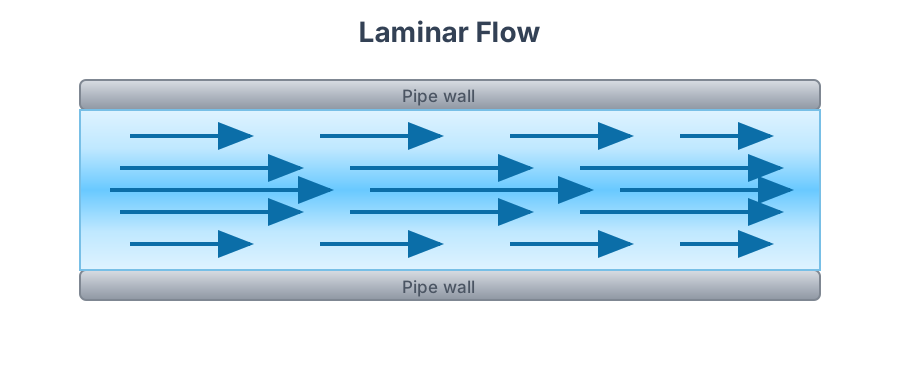
The next layer of atoms is moving just a tiny bit. The liquid moves faster and faster as you go toward teh center, where it moves fastest.
Try a fun way to visualize the effect. Pretend that inside the pipe are tiny submarines with tiny sailors. The subs have cut the engines, so they go only as fast as the water pushes them.
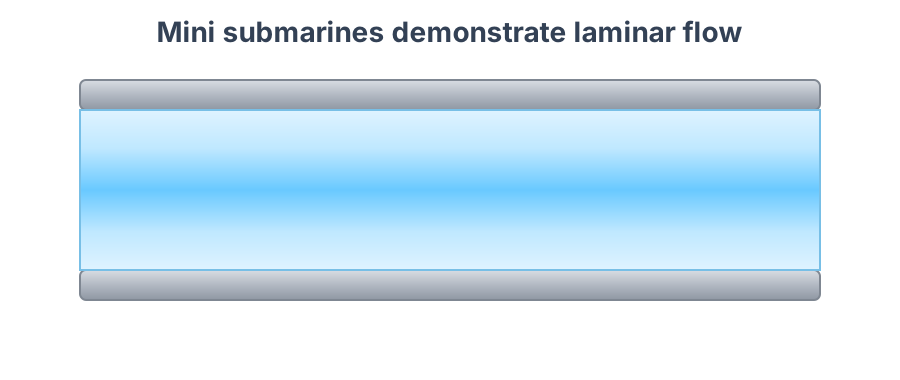
This is laminar flow. The "layers" do not mix or interfere with each other, and the flow is smooth. Our sailor get a relaxing ride through the pipe.
What Reynolds number measures
The Reynolds number is a ratio. That means it that has no dimensions. The Reynolds number compares a flow's inertial effects with its viscous effects.
In other words, it compares the fluid's tendency to keep moving with its tendency to slow down or stickiness.
The Reynolds number combines speed, pipe size, density, and viscosity into one number so you can judge how the flow tends to behave.
For flow in a round pipe:
- — Density of the fluid (mass per unit volume).
- — Average speed of the flow along the pipe.
- — Inner diameter of the pipe.
- — Dynamic viscosity of the fluid (how strongly it resists shearing).
When the Reynolds number gets to about 2,000, the flow switches from laminar to turbulent.
A Bumpy Ride - Limits to the Model
The sailors are having so much fun that they want to go faster. So they radio the pump operator to crank it up. As the speed increases, everything is smooth, until it's not. At some speed, the "layers" begin to mix, and the flow starts to get lumpy. That is when the flow becomes turbulent.
Use this model to see when flow transitions from laminar to turbulent. Look for the "turbulence zone" in the model. You can get a sense of how much water flows through different size pipe that are typically found in a power plant when the flow is smooth. Try different options and move the volume flow slider. Watch the numbers move.
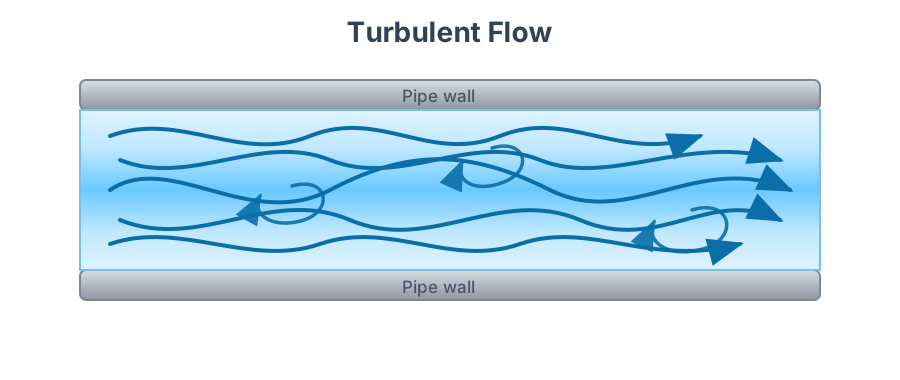
In turbulence, our submarines get shaken, wobbling up and down and tilting as eddies grab them.
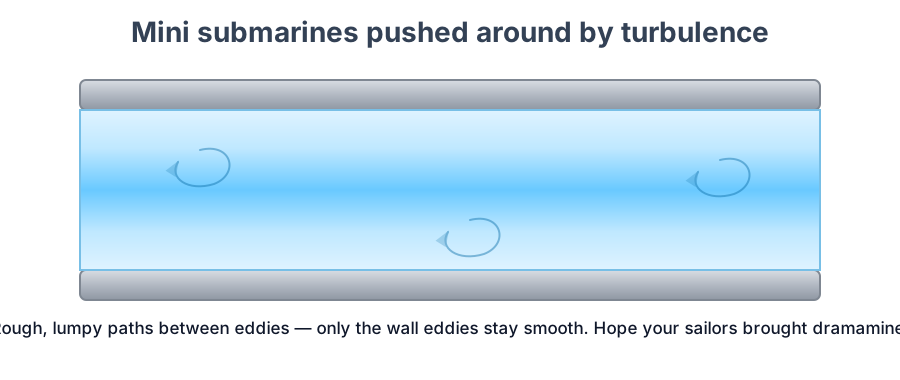
Turbulent flow is even more complicated than laminar flow, so we tackle that in a different model.
Pressure drop ()
In our simulation, the job of the pump is to apply pressure that moves the liquid along the pipe. Without the pressure, the liquid would be still.
The pipe walls slow the liquid down due to friction. The further along the pipe the liquid goes, the more the pressure on the liquid is reduced. This pressure drop is something we calculate in the simulator.
Pressure drop is how much lower the fluid pressure is at the outlet of a pipe run than at the inlet, for a given steady flow. You can think of it as the extra “push” the fluid needs from pumps to overcome viscous friction along the walls.
For laminar flow in a long, straight, round pipe, the equation for combines the volume flow rate , the pipe geometry, and the viscosity:
- — Pressure drop along the length of the pipe.
- — Dynamic viscosity of the fluid (same as in the Reynolds number).
- — Length of the straight pipe segment.
- — Volume flow rate (volume of fluid passing a cross-section per unit time).
- — Inner diameter of the pipe.
Rough trends (still in the laminar range): at fixed , a longer pipe or a narrower pipe raises ; making the pipe wider lowers very strongly because of the in the denominator.
When the flow rate is close to the turbulence zone, this formula is no longer a good model.
Who's Who in History for Laminar Flow
Osborne Reynolds (1842–1912) was an Irish engineer and physicist. He is best remembered here for the Reynolds number and for careful experiments on water flowing in pipes—work that helped clarify when smooth laminar motion gives way to turbulent motion.
Gotthilf Hagen (1797–1884) was a German civil engineer who studied water flow in pipes and channels. His measurements in the 1830s showed how pressure drop and flow rate relate in the slow, orderly regime we now call laminar.
Jean Léonard Marie Poiseuille (1797–1869) was a French physician and physicist. Interested in blood flow in narrow tubes, he measured how liquids move through small glass pipes and published quantitative laws for low-speed flow—work that lines up with what we call Poiseuille flow today.
Hagen and Poiseuille arrived at similar pipe-flow results by experiment, around the same era; the combined name Hagen–Poiseuille reflects that shared legacy.
Honorable Mention
Hagen and Poiseuille worked from experiments. The deeper math came later.
Claude-Louis Navier (1785–1836), in France, put viscosity into the equations of motion in the 1820s.
George Gabriel Stokes (1819–1903), in Britain, finished the form we call the Navier–Stokes equations. In 1851 he published a theory of laminar flow in a round pipe that fits those early measurements.
The Navier–Stokes equations tie pressure, viscosity, and motion together for fluids everywhere—not just inside a pipe.